Are you all thinking I am a know it all snob? I know I sound like it at times. But I don't hold others to any standard higher than I hold for myself. Really. Ask anyone who knows me. I am not overly serious at work. I am pretty fun to hang with and I can liven up a teachers' lounge in seconds. I am a firm believer that teachers are people too and that often we are expected to not be human. I have my unprofessional moments. I use school email to communicate my frustrations very unprofessionally at times. I have said less than kind things about families and kids to my most trusted peers. I have ripped county social workers apart instead of working collaboratively with them. I am human first, Queen of EBDland second.
OK. I started the third class this past weekend. So I have school communication and strategic planning, school finance, and ed leadership. I have yet to really click with any of my classmates. So many high school coaching males. So many small town, young female elementary teachers. I am in constant ponder mode trying to figure out why I feel no connection to the others. Perhaps I am too judgmental. I just have little to no tolerance for those who don't think critically. I also find myself feeling quite impatient with those that are all about getting the assignment done with no real thought or depth...just get it done. This degree shouldn't be only about jumping through hoops, should it?
Anyway, did anyone see the PBS special about two principals in poor performing schools? Wow. NPR did a nice 15 minute interview with both principals prior to the show airing. Check it out.
The show itself had me considering getting a principal license along with my director of special ed license. If I had no kids of my own I would do it. The hours a truly effective principal has to put in to do the job right are endless. The show made me ache to be back in the mix. I do so miss the connections, the interactions, the joys and the challenges. So, I pondered my direction quite a bit this weekend.
How do I apply what I know I am good at and love to being an administrator or program support in special education? So much of those jobs are about meetings, politics and secret keeping. Cover Your Ass seems to be the motto. And while covering my fluffy, hail damaged ( I don't have cellulite, I have hail damage...totally not my fault, right?) rear end is a good practice, I think we have taken it a bit too far. Fear serves a purpose...it keeps us in line at times, but really, parents don't want to sue. They just want what is best for their kids and it has been my experience (personally and professionally) that if there is trust and a sense that all concerned are genuinely interested in giving the kids the cadillac model, not the pinto, things goes well.
So, at this spot of the journey, I have decided to only take a job that allows me to be with kids and their teachers, to model what I do best, to spot teachers who need a break, to know all the families of the speical ed kiddos...not just the ones like my husband and I who nag and prod and keep our name at the top of all district lists. So far that seems reasonable
I realize I am probably quite naive about what is possible. That's OK.
Monday, September 21, 2009

Wednesday, September 16, 2009
Malcontent?
Two classes started, a third to start this weekend. I am disappointed that the emphasis in each class is on principalship. Not once has special education been mentioned. I realize that most of my classmates are aiming to be principals but it is a bit bothersome that it is up to me to adapt each assignment to fit my needs. Special Ed is often the step child with baggage all its own.
I really complain a lot. Malcontent?
Perhaps.
Probably.
Certain.
There is no doubt I am struggling with my decision. I am not sure I have what it takes to be an effective administrator. In certain situations my edit button does not work. Sometimes I think that is good. We need administrators who call it as they see it and expect better from service providers and public education as a whole. Why is it that in education we suffer from fear of upsetting others. We are all so nice. We follow the union protocol of going to the person first and resolve issues that way. I have come to think that is good practice in certain situations, and absolutely bad practice in others. It gets muddled when you repeatedly observe poor practice in student-teacher relationships and teaching methods. We are also told by our union that we are not to assume any sort of supervisory role or sit in judgement of one another. Oh brother. Let's just feed the fires of mediocrity. Going to a colleague to make gentle suggestions takes nerve.
Many just look the other way and rationalize that kids survive, no real damage done. Some say it is not their concern and hide in their rooms with the door closed. Others sit and stew but do nothing. A few bring their concerns to the principal where no action is taken for any number of reasons. Principals cannot see everything in a day. You figure that they spend a minimum of 4 hours per required observation; pre-conference, observation, write up, post conference. And let's be honest here. Any teacher can look really good for one observation hour a year.
I am all for leadership helping weaker teachers get it right. But they both have to want to get it right. Let's be honest for a moment though. How many principals have the time or the knowledge to do this? This takes time. Big time. But if we don't invest more in what goes on in the classroom and special education programs we perpetuate mediocrity and burnout.
As teachers, many of us make those teacher requests for our own kids. We know who is good, we know who to avoid for our own kids. If my colleagues aren't requesting me for their own kids, I need to be counseled out of teaching. But who is going to do that? A principal can try, but the union catches wind and it turns into a divisive battle. As a union member, I want my union to help those who do not belong in teaching find another career. I don't want them to defend to the end a teacher's rights. What about the students? Yes, I want the district to invest in my colleagues. Yes, I want my union to make sure I am fairly evaluated. Yes, I want them both to counsel all but the very best right on out of education.
I sure did not intend to write about this today, but I am trying to allow the thoughts to flow as they will. For a control freak like me, that's a bit of a challenge.
Now, back to my classes...ponder this. If a professor who insists on being called 'Dr.' and who spends much time lecturing the class about quality writing and only turning in perfection (no typos, spelling errors, grammar mistakes) hands to the class a 7 page document written by the professor and it is full of typos, spelling errors and poor sentence structure, how much credibility do they lose?
Malcontent? No, just expecting 'Dr.' to practice what he/she preaches and to drop the pretentious expectation that we all refer to him/her as 'Dr.' Really, we all respect the work done to earn that title. However, Dr., you spent one third the time in the classroom I have, and I am old enough to be your mother!
I really complain a lot. Malcontent?
Perhaps.
Probably.
Certain.
There is no doubt I am struggling with my decision. I am not sure I have what it takes to be an effective administrator. In certain situations my edit button does not work. Sometimes I think that is good. We need administrators who call it as they see it and expect better from service providers and public education as a whole. Why is it that in education we suffer from fear of upsetting others. We are all so nice. We follow the union protocol of going to the person first and resolve issues that way. I have come to think that is good practice in certain situations, and absolutely bad practice in others. It gets muddled when you repeatedly observe poor practice in student-teacher relationships and teaching methods. We are also told by our union that we are not to assume any sort of supervisory role or sit in judgement of one another. Oh brother. Let's just feed the fires of mediocrity. Going to a colleague to make gentle suggestions takes nerve.
Many just look the other way and rationalize that kids survive, no real damage done. Some say it is not their concern and hide in their rooms with the door closed. Others sit and stew but do nothing. A few bring their concerns to the principal where no action is taken for any number of reasons. Principals cannot see everything in a day. You figure that they spend a minimum of 4 hours per required observation; pre-conference, observation, write up, post conference. And let's be honest here. Any teacher can look really good for one observation hour a year.
I am all for leadership helping weaker teachers get it right. But they both have to want to get it right. Let's be honest for a moment though. How many principals have the time or the knowledge to do this? This takes time. Big time. But if we don't invest more in what goes on in the classroom and special education programs we perpetuate mediocrity and burnout.
As teachers, many of us make those teacher requests for our own kids. We know who is good, we know who to avoid for our own kids. If my colleagues aren't requesting me for their own kids, I need to be counseled out of teaching. But who is going to do that? A principal can try, but the union catches wind and it turns into a divisive battle. As a union member, I want my union to help those who do not belong in teaching find another career. I don't want them to defend to the end a teacher's rights. What about the students? Yes, I want the district to invest in my colleagues. Yes, I want my union to make sure I am fairly evaluated. Yes, I want them both to counsel all but the very best right on out of education.
I sure did not intend to write about this today, but I am trying to allow the thoughts to flow as they will. For a control freak like me, that's a bit of a challenge.
Now, back to my classes...ponder this. If a professor who insists on being called 'Dr.' and who spends much time lecturing the class about quality writing and only turning in perfection (no typos, spelling errors, grammar mistakes) hands to the class a 7 page document written by the professor and it is full of typos, spelling errors and poor sentence structure, how much credibility do they lose?
Malcontent? No, just expecting 'Dr.' to practice what he/she preaches and to drop the pretentious expectation that we all refer to him/her as 'Dr.' Really, we all respect the work done to earn that title. However, Dr., you spent one third the time in the classroom I have, and I am old enough to be your mother!
Friday, September 11, 2009
Light Saber at the Ready
Well, last night the journey began. No gentle entry into the perspective on the dark side. School Finance was the course of the day and will be where I sit every Thursday evening this semester.
Instructor is good. Has spent far more years as an administrator than a teacher. So far my original observation that many administrators were not in the classroom too long before they started bossing us all around is proving true. He emphasized how you can't do it all and prioritizing is key. We brainstormed what was important to support in the budget. I got the message loud and clear that the teacher thought we were all a bit naive and idealist. This is what I suspected would happen. But I held fast. I kept my light saber at the ready.
My classmates are a group of 12, I make 13. 10 males and 3 females. Most of the males also coach but teach a variety of content. About half don't want to be administrators, love teaching and are working on a master's degree in leadership, and half want desperately to get into administration. Only two of us want to be special ed administrators. Most have been teachers for more than 10 years. Yes! Much of the class will focus on district and building budgets. I certainly hope we can explore departmental budgeting as that is what my reality will be.
I have already made one impassioned speech in class...dear God, I am sure I have embarrassed myself already. The wonderful thing about being in my 50's is that I don't much care.
As you all know, this transition out of my daily routine and duties in EBDland has been emotionally charged and quite the challenge. I have stayed away from school in order to give my replacement lots of room to establish herself as Queen of EBDland. I did visit the old place yesterday on an errand. I went directly to the office, made my drop off and as I turned to leave saw my old parapro and one of my kiddos...who is a total mess and in the throes of a behavior mod program when what he needs is someone to love him up and allow him to exhale all the crap he endured over the summer.
So the day was a mix for me. Introduction to administrative perspective with a great reminder that it is all in the relationships we have with kids that makes the real difference. So far I am sticking to my intention to keep many caring and knowledgeable teachers and paras next to kids and to do all I can to make sure they have the time and resources to connect to kids with special needs.
The dark side hasn't sucked me in yet....yeah, I was able to keep it at bay for a whole three hours last night. My light saber is already tucked away in my briefcase for tonight.
Instructor is good. Has spent far more years as an administrator than a teacher. So far my original observation that many administrators were not in the classroom too long before they started bossing us all around is proving true. He emphasized how you can't do it all and prioritizing is key. We brainstormed what was important to support in the budget. I got the message loud and clear that the teacher thought we were all a bit naive and idealist. This is what I suspected would happen. But I held fast. I kept my light saber at the ready.
My classmates are a group of 12, I make 13. 10 males and 3 females. Most of the males also coach but teach a variety of content. About half don't want to be administrators, love teaching and are working on a master's degree in leadership, and half want desperately to get into administration. Only two of us want to be special ed administrators. Most have been teachers for more than 10 years. Yes! Much of the class will focus on district and building budgets. I certainly hope we can explore departmental budgeting as that is what my reality will be.
I have already made one impassioned speech in class...dear God, I am sure I have embarrassed myself already. The wonderful thing about being in my 50's is that I don't much care.
As you all know, this transition out of my daily routine and duties in EBDland has been emotionally charged and quite the challenge. I have stayed away from school in order to give my replacement lots of room to establish herself as Queen of EBDland. I did visit the old place yesterday on an errand. I went directly to the office, made my drop off and as I turned to leave saw my old parapro and one of my kiddos...who is a total mess and in the throes of a behavior mod program when what he needs is someone to love him up and allow him to exhale all the crap he endured over the summer.
WARNING! I am stepping on soapbox. Skip the next paragraph if you like.
Behavior mod does not work with kids who are suffering neglect and abuse and are so emotionally and psychologically bound. Point systems operate on the premise the kids can make the right choice but choose not to. When done right, they should be very individualized and developed after baseline data has been gathered. A kiddo suffering from abuses and mental health issues, isn't choosing to make bad choices simply for the sake of making bad choices. They do what they do to survive. All those ugly behaviors serve a very specific purpose for those kids. It is our job to help them figure it out, feel safe, adjust their perceptions of the world. Brain chemistry in survival mode prohibits learning. It's not a choice. Just stepped off soapbox.
I was asked by my para if I could bring another kiddo (my very favorite one!) a t-shirt as he wore a sweatshirt and it was already in the 80's. I popped back home, brought back t shirts, was invited in to visit my wonderful principal and we chatted with the kiddo. What a joy to connect and hug him up! So the day was a mix for me. Introduction to administrative perspective with a great reminder that it is all in the relationships we have with kids that makes the real difference. So far I am sticking to my intention to keep many caring and knowledgeable teachers and paras next to kids and to do all I can to make sure they have the time and resources to connect to kids with special needs.
The dark side hasn't sucked me in yet....yeah, I was able to keep it at bay for a whole three hours last night. My light saber is already tucked away in my briefcase for tonight.
Wednesday, September 9, 2009
Fine Line...But Should it Be?
As I consider topics for this blog and as I contemplate how to discuss issues that come up in the classes I take to become a special ed administrator, I find myself in quite the dilemma. Ethics might be involved here.
(Keep in mind as you read further that 'them' and 'they', do not mean all. In my long career I have worked with some excellent administrators. This blog is all about my journey of transformation and I use past experience with good and poor administrators as my guide.)
I have been a public school teacher for 18 years. With that comes the responsibility to keep certain things confidential as well as to be a mandated reporter of neglect and abuse. There is much neglect in schools. How does one report that? Which takes precedence? Protecting our profession (confidentiality) or reporting what is not so good (neglect)?
While much is good in the world of special education, very much is not. In every district I have worked and sent my own children, there is much withheld information about daily practice. Parents don't necessarily know how personnel cuts are really affecting the programs their kids are in. While we (parents of special education students) receive our Parent's Rights handbooks every year, it is not light reading. And I am a special education teacher! Parents don't necessarily know what options to explore or who to go to when they sense something is not quite right. They don't know they can ask for something better.
In every district I have worked and had my children attend, certain realities about services have been withheld. Most often parents are given the "company line" with a PR approach one cannot get around. Very few discussions are of any depth.
For example, if a parent questions the lack of necessary personnel in a program and they feel it is affecting their child, they are told to go to teacher first, then principal, then special education, then superintendent if needed. So, good compliant parent does this, but once the concern is brought to the table, principal usually calls up the ladder as warning that this parent is asking questions. The bulletproof glass walls go up and as parent gets higher and higher up, all they get is the "company line" and reassured over and over that the district is monitoring the situation. Done.
I don't want to incriminate any specific people or districts, but I want to have open honest disclosure so that real problem solving can be explored. Public education is so busy covering its ass (which is a full time job!) that it has lost sight of what really matters...
So, as I go through this process of becoming an administrator, my theory is that my many years of experience will serve me well, will make me a better leader, manager, visionary. I want to take us from mediocrity to excellence.
As I blog through this I will be mindful of how I express any outrage or frustration I experience. I won't purposely incriminate anyone. But I will use fictionalized versions of real life examples from all the districts I have worked in (6) without benefit of time frame.
This should solve my ethical dilemma. How much to say, how much to hide...all while kindly exploring the issues.
(Keep in mind as you read further that 'them' and 'they', do not mean all. In my long career I have worked with some excellent administrators. This blog is all about my journey of transformation and I use past experience with good and poor administrators as my guide.)
I have been a public school teacher for 18 years. With that comes the responsibility to keep certain things confidential as well as to be a mandated reporter of neglect and abuse. There is much neglect in schools. How does one report that? Which takes precedence? Protecting our profession (confidentiality) or reporting what is not so good (neglect)?
While much is good in the world of special education, very much is not. In every district I have worked and sent my own children, there is much withheld information about daily practice. Parents don't necessarily know how personnel cuts are really affecting the programs their kids are in. While we (parents of special education students) receive our Parent's Rights handbooks every year, it is not light reading. And I am a special education teacher! Parents don't necessarily know what options to explore or who to go to when they sense something is not quite right. They don't know they can ask for something better.
In every district I have worked and had my children attend, certain realities about services have been withheld. Most often parents are given the "company line" with a PR approach one cannot get around. Very few discussions are of any depth.
For example, if a parent questions the lack of necessary personnel in a program and they feel it is affecting their child, they are told to go to teacher first, then principal, then special education, then superintendent if needed. So, good compliant parent does this, but once the concern is brought to the table, principal usually calls up the ladder as warning that this parent is asking questions. The bulletproof glass walls go up and as parent gets higher and higher up, all they get is the "company line" and reassured over and over that the district is monitoring the situation. Done.
I don't want to incriminate any specific people or districts, but I want to have open honest disclosure so that real problem solving can be explored. Public education is so busy covering its ass (which is a full time job!) that it has lost sight of what really matters...
- Taking care of teachers who take care of kids.
- Ensuring quality programs for students with special needs.
- Developing and using appropriate evaluation tools that reflect how special education teachers deliver services.
- Providing meaningful staff development.
- Providing teachers with what they need to be effective.
So, as I go through this process of becoming an administrator, my theory is that my many years of experience will serve me well, will make me a better leader, manager, visionary. I want to take us from mediocrity to excellence.
As I blog through this I will be mindful of how I express any outrage or frustration I experience. I won't purposely incriminate anyone. But I will use fictionalized versions of real life examples from all the districts I have worked in (6) without benefit of time frame.
This should solve my ethical dilemma. How much to say, how much to hide...all while kindly exploring the issues.
Sunday, September 6, 2009
EBDland Magic
About 2 years ago, my dear friend and building art teacher (DF) suggested we try weaving with my students. We had set up a small table loom for one of my most significant offenders earlier and he took to it. DF saw a district offering of a floor loom and nabbed it. It came in a million and one unidentifiable pieces and we decided we needed to write a grant.
Let me insert here that I knew nothing about weaving and was just sort of humoring DF. I am, however, a weak knitter, a crafter, come from a family of crocheters, knitters, needleworkers, and weavers. I know first hand that there is something quite soothing about using one's hands to produce. So my formal information gathering began.
In order to write a grant you need to justify your request and it needs to be based in some sort of truth/research. Where to start? I revisited Brain Gym philosophy and techniques and even contacted them. I contacted weaving guilds all over the US asking for testimonials about what weaving does for the weaver. Amazing responses and offers followed. DF and I decided we were on to something and continued to write the grant. We had a bit of help from my sis (fiber arts prof at a nearby university) and wrote a kick ass grant all based on rhythmic repetitive movement providing a sense of well-being, a way to self regulate, if you will. Rag rugs would be our product.
Well, we got the 1400 dollar grant. When I opened the envelope, I said, "Shit. Now we gotta do this?!" No lie. Where the hell are we going to find a loom with this budget???
Meanwhile as we were grant writers in waiting, we received a gift of about 100 fitted white sheets from a very smart opportunist who saved them from a landfill knowing DF loved these sorts of finds. These sheets play a very important part in this whole story as we saw their arrival as affirmation that we should move ahead. These would be our first rags for rugs.
Long story short...we found a loom about 70 miles away, drove up, rescued it from a lonely unproductive life, paid $475.00 for it, named it (Aunt Sally) and brought her to EBDland (my room). She is a 100 year old floor loom and has a presence you cannot ignore. The
kids responded in awe and respect. Aunt Sally was magic before she was even ready to use. All sorts of acts of aggression happen in EBDlands across the country. Rooms and property are destroyed regularly. Well, not once has Aunt Sally been touched in an act of aggression. She is sacred without us even suggesting to the kids that they cannot hurt her.
OK, we get her up and going. We put the sheets in dye baths, used our newly acquired rag cutter (this is an amazing little tool!) and balled yards of dyed sheet strips. Did you know that you can get about 70 yards of a continuous 1-2 inch strip out of a double bed fitted sheet? Yes, we had math lessons imbedded in this!
Aunt Sally ready to go in EBDland
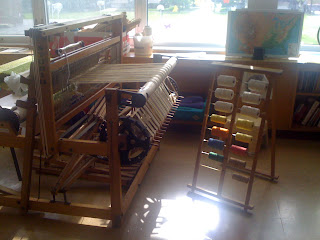
Sis came over, helped us load the loom and we were off. DF got a sub for a full day so she could teach every EBDland resident how to weave and care for Aunt Sally. These kids were to be the experts. They in turn were to teach other nonEBDland residents how to weave. Reaching out is a basic component of this project. Having our kids seen as experts at making something beautiful rather than experts in destruction is significant. Helping our kids redefine themselves as such was key.
Remember, we were hoping against all hope that weaving would help our kids self regulate. That was still just a theory at this point. We knew we did not want the weaving to be used as a reward or punishment, but always offered as a tool of self regulation. As you all know I do not run a behavior mod based program, but we still struggled at times with allowing kids to weave when the math was not done....but guess what? Weaving first got the math done..and done well! Using Aunt Sally must always be initiated by the student.
At the end of the first year, the kids had woven 40 rag rugs. 40 beautiful rag rugs. All designed by the kids. We laid all the rugs out on the EBDland floor, and the kids invited adults they felt connected to and wanted to show gratitude. Watching those adults walk through the rugs commenting and praising and selecting the one for themselves was priceless. The kids were artists, crafters, gift givers! Magic!
What we saw and continue to see with Aunt Sally is that she is used as a self regulation tool. The kids come to her upset, agitated, frustrated, sad or unmedicated. They sit on her bench, touch the beam, run their hands over the rug being woven and begin to pass the shuttles back and forth, pull the beater bar toward themselves and soon they get into their own unique weaving rhythms. I can tell without looking who is at the loom by the rhythm I hear. Faces relax, heart beats regulate, breathing steadies. After about 15-20 minutes the students get up when ready and get on with the day. Magic. When a kiddo is at the loom and another angry one walks in, they invariably offer Aunt Sally and make room for the new entrant. Magic. The kids have NEVER argued about a rug design, a rug, or the quality of craftsmanship. Magic.
Other district EBD teachers are collaborating with art teachers and writing grants for looms. We have presented at luncheons and at staff development workshops. We have steady sheet donations, lots of visitors and a school community that values Aunt Sally. It is pure joy to see my kids demonstrating to whole art classes how to use Aunt Sally. DF regularly brings her classes in for demonstrations and my kids never fail to shine. Magic.
You will hear more about Aunt Sally. There is so much more to tell.
Saturday, September 5, 2009
Questions I Lose Sleep Over
Today is dedicated to questions I have. If anyone can please provide reasonable answers, I would be much obliged.
1. Why is this situation equitable or child centered? In one building we have 5 elementary self contained severe EBD kiddos with two teachers and a parapro. Across town we have 14 children ranging in grades 1-6 with autism on all points of the spectrum, some functioning as two year olds (yep, still in pull ups!), 1 teacher and 2 parapros. 14 kids!! Really? That poor teacher gets up every day, goes to work and does her best...which is pretty damn amazing....but she is basically rendered ineffective due to the above mentioned circumstances.
2. When a transfer student comes to a new district and the IEP states self contained and one-on-one aide, how can New School District administration ignore that and tell receiving teacher there is no money to do it that way...that's against the law!!! So, how can they sleep at night after they direct the receiving teacher to rewrite the IEP so it does not include aide or self containment...and then expect that teacher to pull it off while meeting the needs of the other 13 kids on her caseload per their IEPs?
3. How can districts justify having administrators with no real in-the-trenches expertise? They cannot provide the direct service providers any relevant feedback, guidance or support and yet they still feel they are valuable and necessary to the organization. Huh? No way this would fly in the private sector.
4. Who is really minding the special education store!?! Who knows what is best and why aren't they driving the bus?
5. When are districts going to realize that different evaluation instruments are needed when evaluating special education teachers? Effective evaluations do not come in one size fits all.
6. Why aren't parents more outraged, pounding down doors, calling state departments of education and student advocate groups? Never mind answering this one. I already have that answer. They just don't know better, are relieved that schools will take their kids for 7 hours a day and have no idea what their rights truly are. They are exhausted and overwhelmed.
So am I.
Wednesday, September 2, 2009
And So it Begins
I was good yesterday. First day of school and I was not the least bit sad to not be in my old room figuring it all out. Don't get me wrong. I am still really angry and disturbed by what is going on in my old program but not my deal any longer. I am even more clear about my new purpose and will embrace my administrative license courses with rigor and unwavering intent.
Ignorance can be bliss and I could use a touch of that as mom of two special needs kiddos. Night before last night was open house so they could visit their rooms and unload their supplies. I wish I was ignorant about what it takes to be a quality special education teacher. Movie Man (big brother) has an LD teacher who is a lovely lady, but in the throes of a personal crisis. Superman (little brother) is new to this school, has an AUT teacher new to the school. Nice enough, but has a poor reputation in the district, although I have been pleasantly surprised and pleased thus far. What is working for me is that I have a good reputation as a special ed teacher in our district and I think my kids' teachers will do their best as they know I know.
I sound like an intolerant, judgmental know it all. I am. But not in a bad way! Really. I am a super star EBD teacher. I am current, I change as the kids need me to. What I did last year was not what I did 5 years ago. Most special educators are doing it all the same way they did it when they started... a hundred years ago. EBD kiddos are no longer only the naughty boys that need some behavior mod to change disruptive and self destructive habits. Today's version is comprised mostly of kids wearing some sort of mental illness on their sleeves. Autism has invaded families and schools at astronomical rates. Why in the world have states and universities not invested in developing an Autism license? Why are districts still trying to put these kiddos in EBD programs? Their needs are profoundly different. The two don't mix. And what in the world are district special education administrators thinking when they dump those two types of kids on some poor teacher and expect it to work?
As a mom of special needs kids, I want the best running my kids' programs. I want the top of the line. I want that in their classroom teachers as well. As a colleague/fella teacher, I want to work with top of the line flexible thinkers, seekers of best practice, excellent communicators, strong advocates for kids and their families, and creative problem solvers. I want to know that what I do is appreciated by my administrators and that they are knowledgeable enough to guide me, insist I use best practice, and are very aware of what my colleagues are doing and insist the same from them.
Mediocrity seems to reign and I don't blame the public one bit for not giving us our due props.
On a another note. I go for my final advisement appointment today in preparation for starting my classes next week. I cannot wait to ask all these questions in class. I will push every other student and my teachers to address this very basic issue. How to insist (through gentle but firm nudging and staff development) that all the teachers develop the very best programs to meet the needs of their special needs students. I am interested to know at what point in my administrator license journey I will lose sight of this and become as complacent as my current special ed leadership. I want to lead by example and be in classrooms helping, understanding, shaping, encouraging those teachers interested in doing their best. And for those that are not, I want to compassionately guide them right out of education.
Subscribe to:
Posts (Atom)


